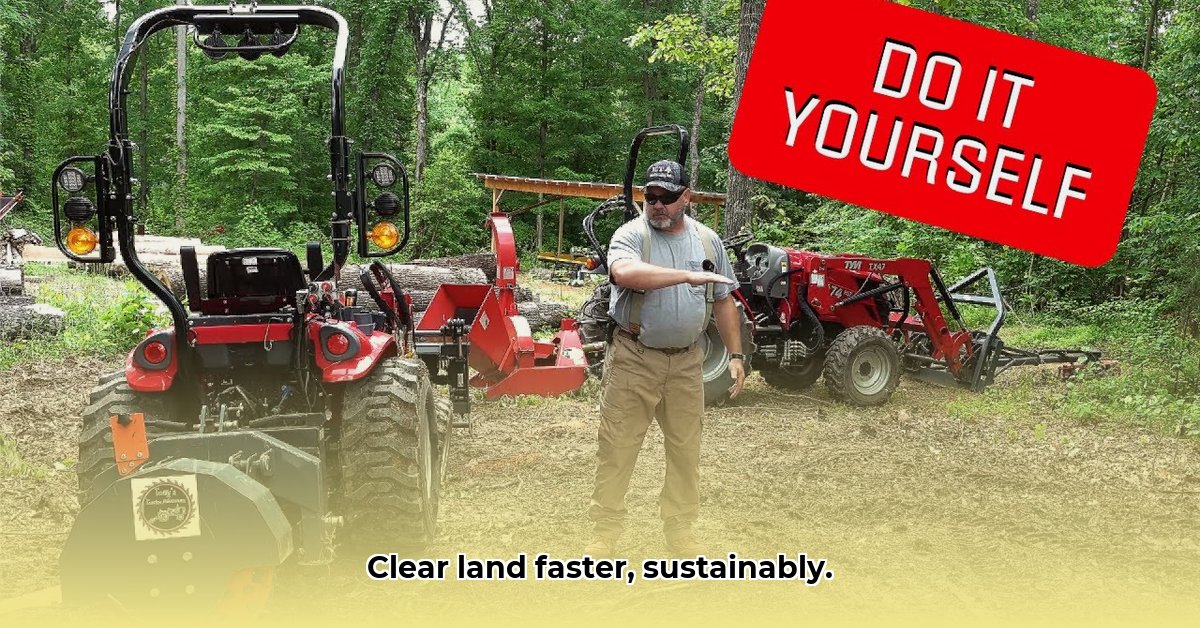
Land Clearing Tractor Attachments: Selecting the Right Tool
Clearing land efficiently and sustainably requires careful consideration of your needs and the available tools. This guide helps you choose the best tractor attachment for your specific situation, focusing on maximizing efficiency while minimizing environmental impact. Factors like the type and density of vegetation, the size of your operation, and soil conditions all play crucial roles in this decision. Ignoring these factors can lead to inefficiencies and potential environmental damage. What are your primary land clearing goals? For more information on auger attachments, check out this resource.
Assessing Your Land Clearing Needs
Before purchasing any equipment, a thorough site assessment is vital. This includes identifying the type and density of vegetation (light brush, dense forest, etc.), assessing the terrain (flat, hilly, rocky), and understanding your soil type. For example, clearing dense forest requires significantly different equipment than clearing light brush. How will your decisions impact the soil and surrounding ecosystems?
Choosing the Right Attachment: Flail Mowers, Drum Mulchers, and Excavators
Several tractor attachments excel at land clearing, each with unique strengths and weaknesses.
Flail Mowers: These use a rotating cylinder of small hammers to shred vegetation, leaving behind mulch. They are versatile and suitable for light to medium vegetation densities but struggle with thick brush or small trees. (Think of a high-speed lawnmower, but much more powerful.) A flail mower might be suitable for maintaining existing pastures or clearing light undergrowth.
Drum Mulchers: Featuring rotating drums with sharp blades, drum mulchers are more powerful than flail mowers and handle denser vegetation effectively. They are ideal for tougher vegetation and rough terrain. (Imagine a powerful wood chipper finely shredding materials.) Drum mulchers may provide a more efficient approach for clearing more challenging vegetation.
Excavator Attachments (Grapples & Buckets): For substantial land clearing projects involving significant tree removal or extremely dense vegetation, excavator attachments offer superior power. However, they cause more soil disturbance and require a higher initial investment and training. (These are heavy-duty options that can remove trees and move significant volumes of material.) Excavators are best suited for large-scale projects where heavy-duty clearing is required.
Comparing Drum vs. Flail Mulchers for Sustainable Land Clearing
Drum mulchers and flail mulchers are both effective, but choosing between them requires careful consideration.
Drum Mulchers: Disc vs. Depth Control
Drum mulchers come in two main types:
Disc Mulchers: These are high-speed machines ideal for large-scale projects with heavier vegetation. They are efficient at processing vast amounts of material but may produce coarser mulch. "Disc mulchers excel at high-speed processing of larger vegetation," says Dr. Emily Carter, Agricultural Engineering Professor at Purdue University.
Depth Control Mulchers: Offering more precise control, depth control mulchers create finer mulch, beneficial for soil improvement and sustainable practices. However, they are less effective on large woody materials. "Depth control mulchers are ideal for enhancing soil health and promoting sustainable land management practices," notes Dr. Robert Miller, Soil Scientist at Cornell University.
Key Differences Between Disc and Depth Control Mulchers
| Feature | Disc Mulcher | Depth Control Mulcher |
|---|---|---|
| Processing Speed | High | Moderate |
| Mulch Fineness | Coarse | Fine |
| Vegetation Size | Larger trees and dense growth | Smaller vegetation and shrubs |
| Soil Impact | Potential for more soil disturbance | Generally less soil disturbance |
| Ideal Terrain | Relatively flat terrain | More adaptable to varied terrain |
Flail Mulchers: A Versatile Alternative
Flail mulchers offer a versatile alternative. Their swinging flails create uniformly sized mulch and are well-suited for diverse vegetation types. The choice between drum and flail mulchers depends on your specific needs. "Flail mulchers provide excellent versatility for a range of vegetation densities," explains John Davies, Chief Engineer at Deere & Company.
Factors Influencing Your Choice
- Budget: Consider both initial costs and ongoing maintenance.
- Vegetation Type: Match the mulcher's capabilities to the vegetation size and density.
- Terrain: Consider slope and obstacles; some mulchers handle uneven terrain better than others.
- Soil Health: Consider the impact on soil structure and nutrient cycling. Fine mulch generally improves soil health.
- Environmental Regulations: Always ensure compliance with local regulations.
Maintaining Your Equipment
Regular maintenance (inspections, cleaning, lubrication, and timely part replacements) is crucial for extending the life of your equipment and ensuring optimal performance. This not only reduces downtime and operating costs but also contributes to safer operation. "Preventive maintenance is cost-effective and enhances the safety of land clearing operations," emphasizes Sarah Chen, Safety Consultant at Environmental Protection Agency.
Prioritizing Safety
Always prioritize safety by wearing appropriate safety gear (eye protection, gloves, hearing protection, sturdy footwear) and following manufacturer instructions carefully. Never attempt tasks beyond your skill level, and seek professional help when needed.
Sustainable Land Clearing Practices
Sustainable land clearing emphasizes minimizing environmental impact. Mulching helps improve soil health, reduces erosion, and may reduce reliance on harsh chemicals. Choosing attachments that balance effectiveness with environmental responsibility is crucial for long-term land health. Remember, sustainable practices provide both short-term and long-term benefits.